Why Dreams Don’t Take Flight
Why do some of the ideas that matter most to us remain unrealized? Explore nine less obvious reasons meaningful dreams can be difficult to bring to life, and what can help us finally give them a real chance.


Why do some of the ideas that matter most to us remain unrealized? Explore nine less obvious reasons meaningful dreams can be difficult to bring to life, and what can help us finally give them a real chance.
After volunteering in Peru with the Pure Art Foundation, Kerrsen returned home deeply changed by the people, the children, and the experience of witnessing both profound poverty and profound humanity. What began as a moment of heartbreak and reflection in the Sacred Valley became a vision… to walk over 1,000 km across Peru in support of building another home for a family in need. One Step at a Time is more than a fundraising journey. It is a story about meaning, courage, connection, and what happens when we choose not to turn away from what deeply moves us.
When life no longer feels aligned, but nothing is clearly wrong, it can be hard to know what to do. This article explores the hidden cost of staying too long and how to recognize when it’s time to respond to change.
A Life Design Scan is a simple, practical way to step back and see where your life is actually working and where it isn’t. By looking across four core areas—work and purpose, lifestyle and expression, relationships, and the health and energy that supports everything—you can quickly identify what needs your attention. Instead of trying to fix everything at once, it helps you focus on the one or two areas that will begin to shift everything else.
At different stages of life, many of us begin questioning the definitions of success we once followed. What once felt meaningful may no longer fit the person we have become. In this reflection, I explore why people across generations are rethinking work, purpose, and contribution—and what these moments of transition may be inviting us to discover.
When Shock Hits the Collective: Why Understanding Patterns Matters Now When long-hidden things surface, the first response is rarely clarity. It is shock. The recent release of the Epstein files has brought deeply unsettling information into public awareness. What is emerging is confronting and disturbing. It raises serious questions about power, influence, accountability, and trust, and it brings into public view dynamics that many people are encountering for the first time. Moments like this do more than expose individuals or events. They expose the limits of the stories societies rely on to feel safe inside complex systems. When those stories begin to fracture, the experience can feel destabilizing. Anger, grief, disbelief, compassion for victims, and a sense of powerlessness often arise at the same time. These are human responses to encountering difficult realities, especially when those realities challenge long-held assumptions about how the world functions. This moment deserves to be acknowledged for what it is. The material being released is not trivial. For many people, encountering this kind of information can feel like a collapse [...]
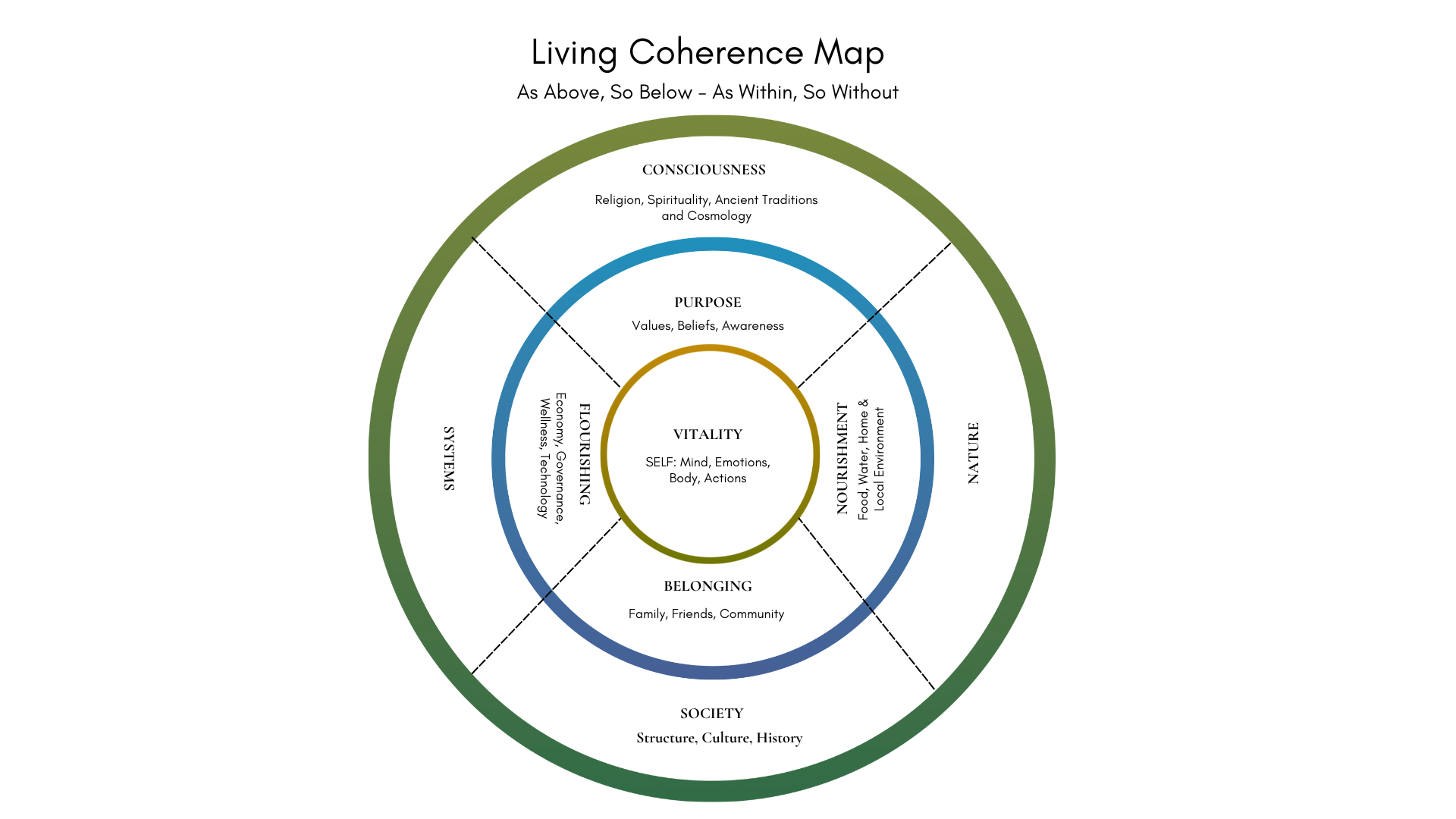
We are living in a time of profound transition. Many feel disoriented as old systems unravel and new ways of living struggle to emerge. The Living Coherence Map offers a grounded way to understand where real influence begins and how wholeness is restored across life’s inner, relational, and global dimensions.
We are living in a time between worlds, sensing that something is ending and something new is trying to emerge. The Living Coherence Map offers a way to orient ourselves within this transition.
At a certain point in life, leadership changes shape. It becomes less about answers and more about presence, permission, and staying in relationship with what is emerging. This piece explores a quieter, more embodied form of leadership for times of transition.
There is a quiet exhaustion moving through the collective right now. Many of us feel pressured to know, decide, and respond too quickly. This reflection explores living inquiry as a stabilizing force — a way of listening more deeply and meeting change with discernment rather than certainty.